

For brands, manufacturers, retailers and suppliers, this means that product information will need to become more complete, more accessible and easier to verify. For the textile and leather industry in particular, the DPP is expected to play a major role in how information about materials, chemical safety, supply chains and end-of-life handling is collected and communicated.
What is a Digital Product Passport?
A Digital Product Passport (DPP) is a digital record that contains key product-related lifecycle information. It is designed to make relevant product data available in a more structured and accessible way.
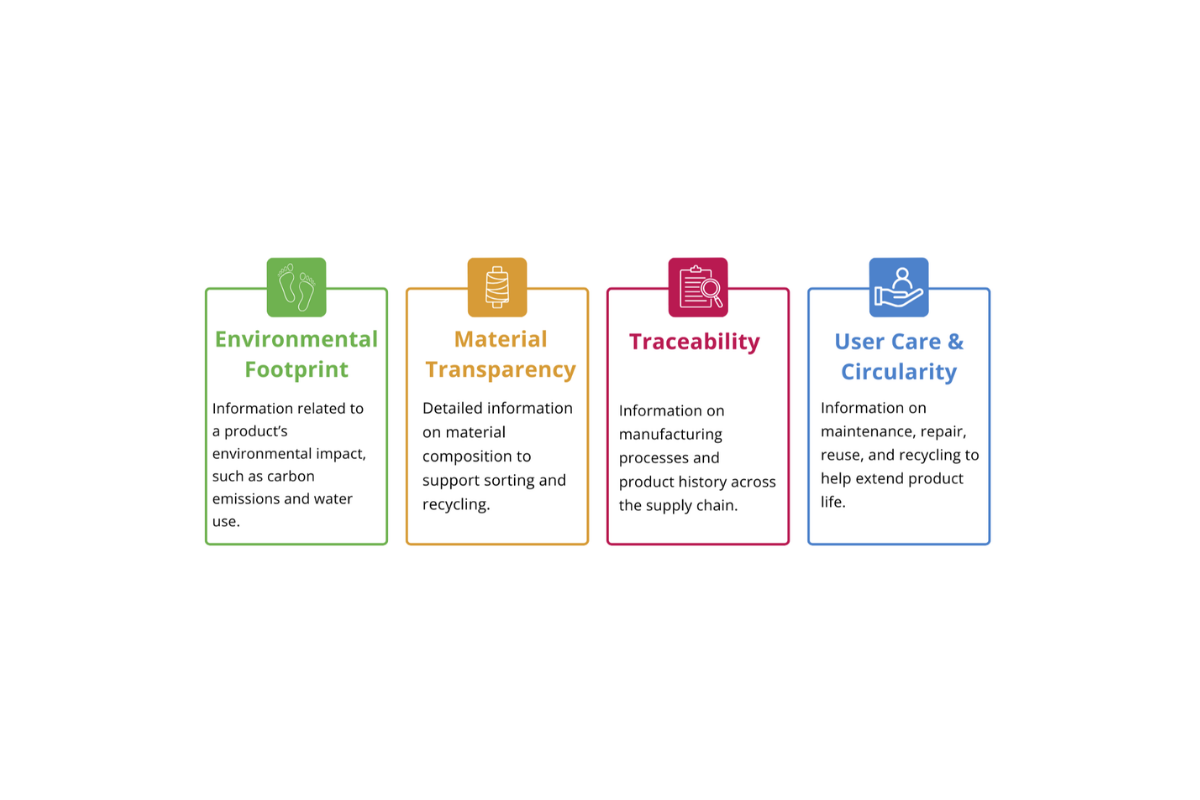
The DPP is expected to include information such as:
- product composition
- production history
- repairability
- recycling information
- end-of-life handling
- relevant sustainability and circularity data
In practice, a Digital Product Passport is generally expected to be accessed through digital carriers such as QR codes, RFID tags or similar technologies. This allows product information to be connected directly to the physical item.
The DPP is intended to go beyond a simple “Made in” label. Instead of only showing origin-related information, it aims to provide a broader and more detailed view of the full product journey.
Why the Digital Product Passport matters for companies in Europe
The scope of the Digital Product Passport is expected to be broad. It may apply to all brands placing products on the EU market. This means that companies headquartered outside the EU may also be affected if they supply products to customers in the European Union.
In addition to large companies, small and medium-sized enterprises (SMEs) are also expected to be within scope, while support measures for smaller businesses are being discussed.
For companies in textiles, apparel, footwear and related sectors, this makes early preparation important. The DPP will likely require companies to collect, organize and communicate product information in a more systematic way than before.
Digital Product Passport timeline: ESPR, textiles and 2027
The Digital Product Passport is expected to be introduced in stages.
A key step was the adoption of the Ecodesign for Sustainable Products Regulation, also known as the ESPR, in June 2024. This regulation established the legal basis for the Digital Product Passport.
Apparel is considered a high-priority category. Footwear may be addressed later under separate detailed rules.
According to the currently available roadmap, more detailed textile-related Digital Product Passport requirements are expected to be formally adopted around 2027. Once the relevant rules are finalized, a grace period of approximately 18 months is expected before full implementation.
This staged approach gives companies time to prepare. However, it also means that the quality, structure and accessibility of product data will become increasingly important.
Digital Product Passport requirements and the role of trusted data
The Digital Product Passport is developing in a direction that requires more structured product information and stronger traceability. Based on currently available public information, discussions are ongoing around both a central system approach for managing information and a decentralized structure connecting different databases and data sources.
In both possible approaches, reliable and verifiable data will be essential.
For textile and leather products, relevant data may include information related to:
- product safety
- chemical inputs
- material composition
- environmental performance
- social conditions in the supply chain
- traceability and transparency
- circularity-related information
This is where existing certification and labelling systems can become highly relevant.